

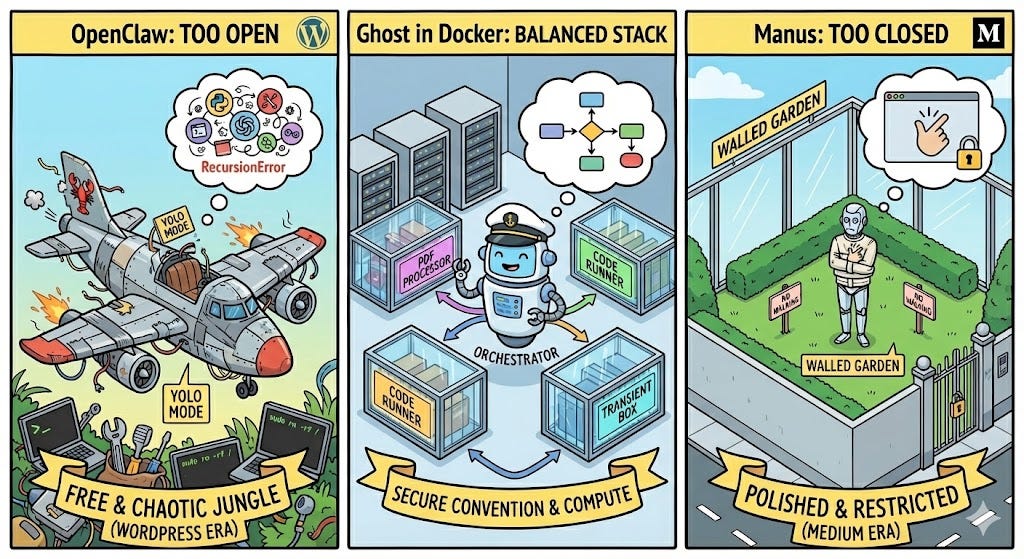
We are currently in the “Geocities/Early WordPress” era of AI agents. If you look at the landscape, two distinct vibes are emerging, and they look suspiciously like history repeating itself.
OpenClaw: The WordPress of 2008
OpenClaw (and similar “yolo-mode” agents) feels exactly like WordPress in 2008. You know the vibe: wp-admin is exposed, the MySQL password is admin123, and there’s a growing list of plugins from questionable sources that might either give you a beautiful contact form or a crypto-miner.
It’s a duct-taped airplane. The wings are shivering, the rotors are violently shuddering, and you feel like it could crash into a RecursionError at any moment. You see the vibe coding slop across the board. The UI overlaps, tool calls fail constantly, and it never tries to hide that it was born in a 48-hour hackathon.
But, like WordPress, it’s free. It’s the “Wild West” where you have a full filesystem scratchpad, you can invoke ffmpeg, imagemagick, and pip install whatever you want in wanton glee. It’s agentic AI at its most chaotic and powerful.
Manus: The Medium.com Walled Garden
On the other side, you have Manus AI. Manus is the Medium of agents. It’s tight, locked down, and centralized. You can only “import” data from 10-15 official connections. It’s polished, sure, but the LLM is wearing a straitjacket. It can’t run a terminal inside a container; it can only use the limited Model Context Protocol (MCP) endpoints the platform exposes.
If OpenClaw is a jungle, Manus is a manicured lawn with “No Walking” signs.
The “Ghost in Docker” Stack
So, where do we go from here?
I think there’s a massive opportunity for the “Ghost in Docker” approach. We need a stack that has the “Convention over Configuration” ease of a 1-click deploy, but with actual security.
Imagine a main agent that acts as the orchestrator, and every time it needs to do something “dirty” (like running code or processing a PDF), it spins up a sub-agent in a transient Docker container. You give it a token limit, a time limit, and a specific set of tools.
This isn’t just “using an LLM.” This is owning a living-breathing “box” on the internet that has both compute and storage. It doesn’t live on a blockchain; it lives in a Remote Execution Environment.
The Austrians are Showing us the Future
While US and China lug it out in models and infra, the OSS-agentic space seems to be a bit of a Europarty right now.
OpenClaw by Peter Steinberger (a Vienna boy), is what made this all so popular. It is built on top of pi.dev as the core agentic loop made by Mario Zechner (of libgdx fame), also an Austrian and finally, the future of tighly controlled environment to run small agentic loops is coming from Gondolin being made by Erandil - also being made by another Austrian hero - Armin Ronnacher (who created Flask)