
Newly 'Emergent' formulae of ARR calculation in the AI SaaS world
AI wrappers reaching $100M ARR is plausible, but I also think some window-dressing is involved in the calculations.

$100M ARR 🚀🚀🚀🚀 tweets are getting very common. Latest was the saga of Emergent declaring this and then few weeks later ensuing Twitter drama that this is all false. I, of course, had some thoughts on this…
NOTE: This is heavily using AI-assisted research and AI-assisted editing from a lot of voice notes and recordings from some calls I had with people.
1) Background context
In SaaS, $100M ARR has always been a serious milestone. Bessemer called companies that cross it “Centaurs”, and the point was simple: revenue is harder to fake than valuation.
Historically, this took years. Salesforce took about 5+ years. Slack did it in roughly 2.5 years. Wiz got there in about 18 months.
Then AI app-layer companies compressed the timeline again.
Cursor hit $100M ARR and then hit $1B ARR in 17 months.
Replit jumped from about $16M to $253M ARR after Replit Agent.
Recently Emergent claimed $100M ARR in 8 months (of which the $50M to $100M part in under 30 days they claim), and the internet did what it does.
Among the drama were some real questions on what is ARR? If ARR is calculated by annualizing recent cash collections, that is different from contracted recurring revenue. Khosla’s view is that cash is cash. Critics argue the ARR label can imply more predictability than the business actually has.
2) The third derivative of growth
Forget Emergent for a second. Why are these curves so steep for AI wrapper companies in the first place?
Because AI SaaS often compounds across three slopes at the same time. If you look at ARR graphs, how do they grow? There are 3 levers.
More accounts: standard new-customer growth.
More seats per account: per-seat pricing compounds as customers hire. This is how GitHub Copilot, Slack, and Linear scale inside existing customers.
More usage per seat: usage-based pricing lets power users spend more over time. See Lovable credits, Cursor pricing, and Bolt token tiers.
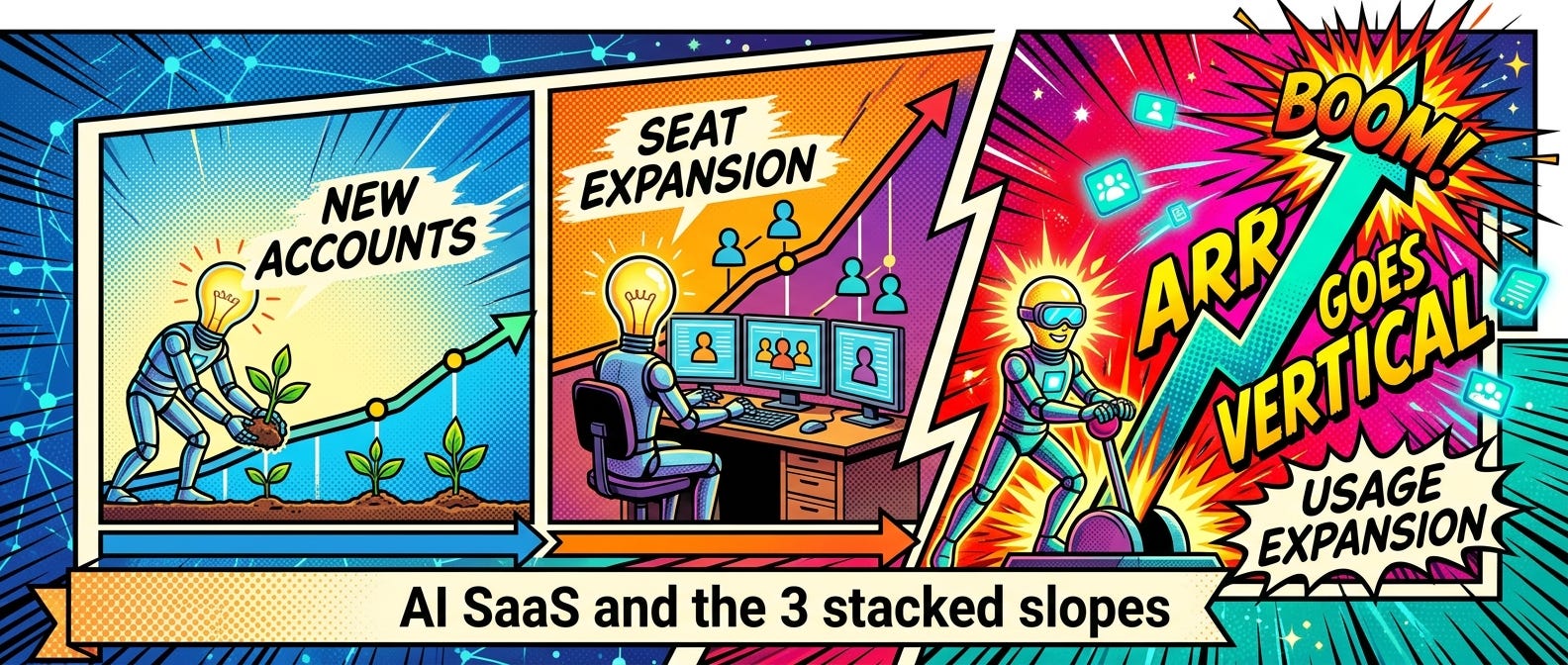
If you visualize the ARR graph in your head, the first slope is the basic incline from adding new customers. The second slope gets layered on top when those customers hire more people and seat count expands. The third slope stacks again when each person starts using more credits or tokens every month. Same account, same seat, higher consumption. Once all three kick in together, the chart starts looking kind of unfair.
Lever 2 is why NRR matters so much. Slack peaked around 132%, Snowflake around 125%, Datadog around 120%.
Lever 3 is the newer turbocharger. Token consumption per org has risen sharply, so existing seats can produce more revenue even without adding headcount.
There is also a behavior loop behind this. With AI tools, output is often close but not done, think 90% there, and that makes one more prompt feel totally reasonable. Gambling research calls this a near-miss dynamic: outcomes that are still losses can still increase the urge to continue because they feel close to a win (Neuron study). A broader review on reward variability makes the same point across digital products, uncertainty plus high-frequency exposure keeps people in the loop (Clark and Zack, 2023).
Short-form feeds run a very similar mechanic. Infinite scrolling and intermittent rewards are strongly associated with repetitive, hard-to-stop checking loops (ACM CHI: The Loop, Telematics and Informatics). AI coding and app-building tools are not literally TikTok, but the interaction pattern rhymes: prompt, partial win, prompt again.
Classic SaaS ARR = accounts x seats per account x price per seat
AI SaaS ARR      = accounts x seats per account x consumption per seat x price per unit
That extra term is why Cursor, Lovable, and Bolt can look absurdly fast.
3) How ARR gets calculated (and stretched)
ARR now gets used for two different things:
Annual Recurring Revenue: contracted recurring value (Stripe, ChartMogul)
Annualized Run Rate: recent revenue multiplied forward (Stripe, Baremetrics)
First layer: annualizing the base ARR number
The first layer is just run-rate math: take current recurring revenue and multiply it by 12, 52, or 365, depending on whether you annualize a month, week, or day. Useful, but still a projection.
Okay, let’s take a real-world example:
You sell an AI tool subscription at $20/month.
You run a promo that lets people sign up at $1 for month one (some teams run this for the first 3 months, too).
You get 100 new users on that promo.
Keeping the maths to the one-month promo case:
Cash collected now = $100 (100 x $1)
Annualized ARR view = $24,000 (100 x $20 x 12)
This is especially common when plans are structured as “annual contract, paid monthly,” sometimes with easy month-one breakout terms. In that setup, teams may describe value as contracted, booked, or accrued annual value, while actual cash realization is still pending (The SaaS CFO).
So the $240 per user is not guaranteed cash. It only materializes if users continue to pay at list price. With promo-heavy cohorts, some users churn in month two, and some are retained only with additional offers like $5 or $10 follow-on months. That can pull realized revenue well below the headline annualized view (Burkland).
Second layer: the “ARR growth” narrative hack
Then comes a separate trick: switching from ARR itself to “growth in ARR.” Example: 5 users sign up today at $1. Cash in hand is $5. But if each user is counted as $240 annual value, you can say “ARR grew by $1,200 today.” Then annualize that daily ARR growth again and you are suddenly “on a $438,000 annual ARR-growth trajectory.”
That is two layers of projection stacked on top of each other. First you annualized a discounted signup, then you annualized the daily increase in that annualized number. This is why announcement threads can look wild in young AI companies and still be technically defensible sentence by sentence.
This pressure is real. Fortune reported that multiple VCs are seeing pilots, one-offs, and not-yet-live contracts presented as recurring revenue in fundraising decks, and Sifted documented the run-rate milestone culture around AI startups.
So no, headline ARR alone is not enough. The fast check is: compare ARR claims with cash collected over the same period, then ask what exactly was annualized, what was discounted, and whether the number describes current contracts or a projection.
4) Can the bottom line afford the addiction?
This is the real question that really decides whether this is a lasting software category or a temporary rush.
The core problem is simple: AI usage can feel cheap to the user while being expensive in aggregate. Yes, model prices are falling. But if every employee runs high-context, agentic workflows all day, the bill is still large. Right now a lot of that bill is hidden by the subsidy chain: model providers, VC-backed credits, and enterprise budgets that are still in experimentation mode (a16z).
Michael Burry’s point in his debate with Jack Clark and Dwarkesh Patel is still the cleanest framing. If everyone buys the same expensive AI escalator, no one gets much strategic advantage, and suppliers can struggle to earn enough to justify the capex. The argument is captured in Dwarkesh’s write-up and this summary.
On productivity evidence, the METR study is important, but you have to read it in time context. It tested early-2025 model stacks on difficult brownfield repositories. That is old by model-cycle standards. Newer coding models are materially better on public software engineering evals, including the official SWE-bench leaderboard and Princeton HAL runs where the same scaffold moved from roughly 50 to 54% with Claude 3.7 to 68 to 72% with Claude Sonnet 4.5 (HAL leaderboard). So METR should not be read as “AI cannot code.” It should be read as “tooling can still add review overhead on complex legacy codebases.”
The 2026 enterprise data is what matters more now. A large multi-country executive survey from NBER and central-bank researchers found 69% of firms already use AI, but most still report little realized impact so far: over the last three years, more than 80% reported no productivity or employment impact. The same firms still expect gains over the next three years: +1.4% productivity and +0.8% output on average. A second 2026 Fed study calls this a productivity paradox, where perceived gains are higher than measured gains, with stronger effects in high-skill services and finance.
Board-level ROI data tells a similar story. In PwC’s 2026 global CEO survey, 30% reported AI-linked revenue gains and 26% reported lower costs, but 56% reported neither, and only 12% reported both. Deloitte’s 2026 enterprise report is directionally consistent: 66% report productivity or efficiency gains, but only 20% report revenue increase so far, while 74% say revenue impact is still aspirational.
At the macro level, 2026 is also a “maybe” year, not a “done” year. The IMF’s January 2026 outlook says AI investment is already a tailwind, but also explicitly warns that if productivity expectations disappoint, markets can correct hard. Their upside case is that AI could add up to 0.3 percentage points to 2026 global growth and 0.1 to 0.8 points annually in the medium term.
So the verdict is not yet truly in. Jury still out, as they say. Adoption is real, for sure. Usage is real, for sure. Some productivity gains are real, for sure. But the financial signal is still uneven, especially outside the best use cases and best operators.
Back to Mr Bury’s question: after subsidies, after pilots, after excitement, does AI spend raise real profits for the buyer?
If yes, this wave compounds.
If not, we might have built Concorde, without enough passengers.
So what about Emergent?
I should say this clearly. I have friends at Emergent, including people on the founding team. I am not insinuating anything about their numbers. I do not have access to their books, and I have no dog in this race.
Could an AI product hit $100M ARR very fast in this cycle? Yes, absolutely possible. If usage is token-driven, and all three slopes are working at once, account growth, seat growth, and usage growth, the curve can move way faster than old SaaS intuition allows.
Could a so-called $100M ARR still be very different from having $100M of locked, repeatable revenue that is guaranteed to show up again next year? Also yes. In usage-heavy businesses, that depends on contract structure, retention, discounts, and how exactly ARR is being annualized.
That does not make the number fake. It makes the number less comparable to classic SaaS milestones.
And one more thing people forget: enterprise revenue is hard to win, but once you win it, it is also hard to lose quickly. Cursor is a good reminder. Even while the internet was declaring it finished and saying Claude Code had already won, Cursor reportedly moved from about $1B to $2B annualized revenue in roughly a quarter. At the same time, Fortune documented the “Cursor is dead” narrative, plus real competitive pressure from Claude Code and talent churn. There were even reports of a rapid talent tug-of-war around Claude Code leaders between Cursor and Anthropic (The Information briefing).
So yes, $100M is plausible.
But even when it is real, in this market, it means less than it used to.