

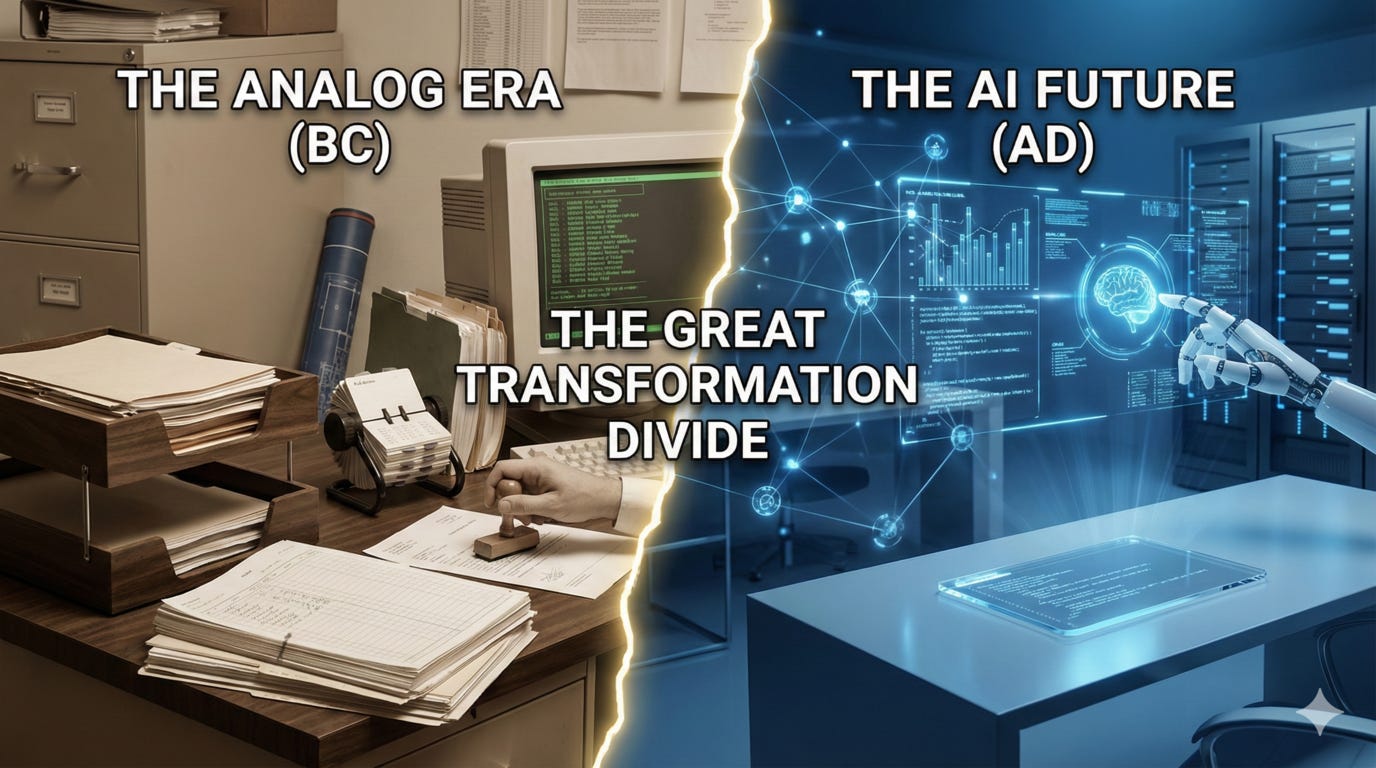
When large organisations started introducing computers into the mix, it was transformative. You can’t imagine how many things we do in computers today was done by hand.
Memories I have from just my own lifetime - going to my father’s office seeing things you can’t imagine if you’ve only seen a post-2010 office setting
1. Physical inbox/outbox on desks of people containing files they are yet to read and sign and files they have signed
2. Office clerks wheeling in these massive stacks of files around
3. Accounting happening in actual large ruled sheets (spreadsheets anyone?)
4. Floor planning happening by drawing diagrams in blue ink on massive white sheets that will then by transported physically to another office for further drawing/verification
5. Almost all shipping/logistics accounting using registers with signatures and counter signatures
6. Obviously a bunch of cash/cheque/drafts used to move money around
I have seen all of these things happen as late as - late 2000s or early 2010s , that’s just barely 15 years ago. And yet, 15 years ago, companies like Google, Microsoft, Amazon, Facebook, Apple were not operating like that. They had moved to digital processes to handle all of this.
In my very early stages of career (moving ahead from my childhood) I have often come across people working in these big organisations in roles called “Digital Transformation” or the same. The people who typically call Tech as IT and so. This existed as late as early 2020s, no kidding. There are massive organisations employing hundreds of thousands of people spanning tens of countries working with billions of dollars of money, who still were on their last leg of digital transformation as recently as 5 years back. Think Target, Walmart, Honeywell, FedEx, Maersk. There are companies like Reliance in India which drive a meaningful % of GDP and yet are not fully digitally transformed.
As the AI wave sweeps across and creates yet another BC/AD divide in the timeline - of employees who are digitally adept but not “AI native” and those who naturally work with AI, the same transformation journey will play out.
There are entire industries (logistics, shipping, govt services, large scale retail) where none of the existing major players are going to transform to AI as fast as say FAANG companies or SaaS companies will do (because they are more adjacent to it). Without any competitive pressure, monopoly, duopoly or triopoly industries can afford to shift much slower. Sure you’re less efficient without AI but compared to whom when none of your competitors are shifting either?
In years to come there will emerge “AI transformation” specialists who’ll drop into these big slow moving ships to turn them around. Often these AI transformation gurus will not even be your typical AI-native hotshots like Karpathy or Boris Cherney or Peter Steinberger types. It is too tedious cumbersome and beneath them. It will often be past VP types from FAANG who saw the carpet shift from under their feet with AI transformation at their own workplace but learnt enough lessons from it to go and implement the same (while navigating the massive org complexities) at slower and larger orgs.
Sure this wave might play out faster than the digital transformation wave (it took GPT to reach 100M much faster than it took Google search to) but it’ll not be in days or weeks, definitely it’ll take years.
The transformation divide you describe is real. But here's what I've observed: organizations rush through analog-to-digital transition, only to find the intensification trap on the other side. New tools don't simplify work—they multiply it. Sustainable transformation requires deliberate pace, not speed. My research on this: https://creatism.substack.com/p/the-intensification-trap-part-2
Really sharp take on this. The parallell to digital transformation is spot on, and recognizing that it'll be FAANG ex-VPs not the Karpathy types leading this at big corps is pretty insightful. I've watched startups race ahead with AI adoption only to burn out fast, while slower orgs that took time to integrate it properly ended up way more resilient longterm. Sometimes the slog is actually the feature not the bug.